Table of contents
What is a Phlebotomy Technician? Job Duties, Work Settings, and More
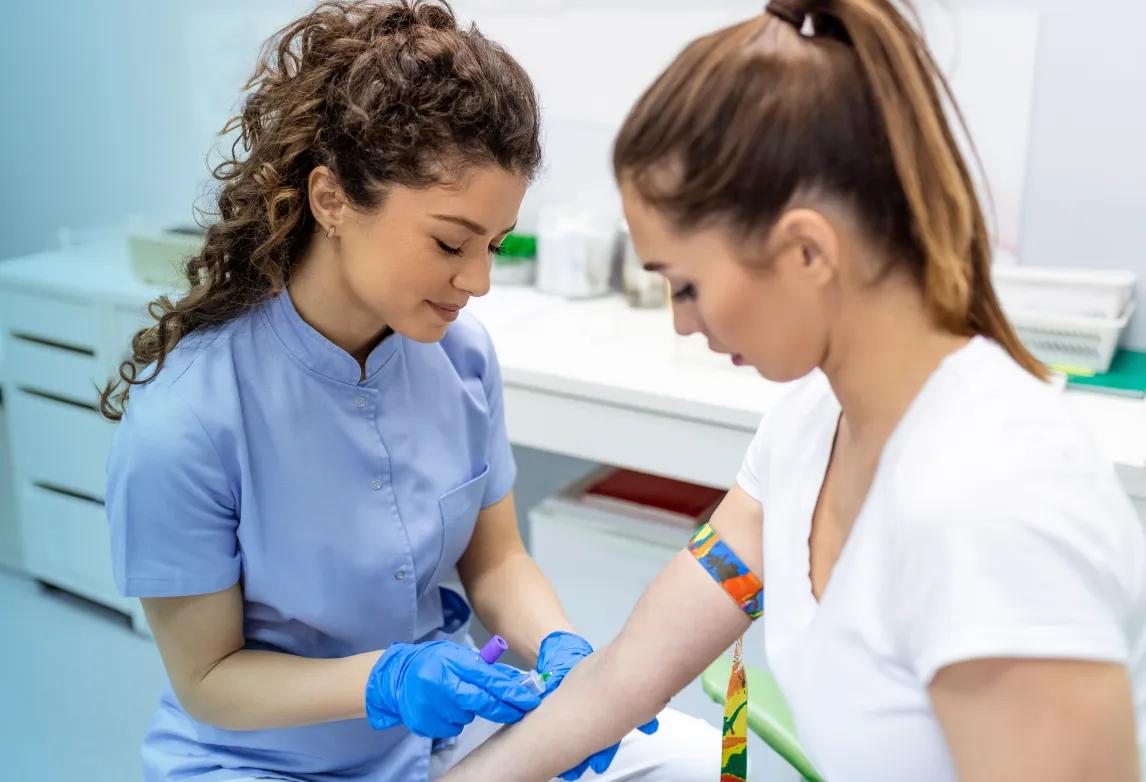
Table of Contents
Key Insights:
-
Phlebotomy technicians, also known as phlebotomists, can draw blood, collect other specimens, label and handle samples, and more.
-
Reasons to consider this healthcare career path include increased demand, training that can often be completed in under a year, and potential room for advancement.
-
Ultimate Medical Academy's Phlebotomy Technician Diploma program can prepare you to pursue a career in this role and includes an 80-hour externship and preparation to sit for the Certified Phlebotomy Technician (CPT) exam offered through the National Healthcareer Association upon meeting eligibility requirements.
Formerly known as bloodletting, phlebotomy is the act of drawing blood with a needle.1 Patients may need their blood drawn for diagnostic, treatment, donation, or research purposes, making this act important for a variety of reasons.
One healthcare role that can perform this function is a phlebotomy technician. If you’re interested in this as a potential career path, it can be helpful to understand what professionals in this role do, where they work, and more. Let’s start with the basics.
What Is a Phlebotomy Technician?
Phlebotomy technicians have one primary job function: to draw blood and collect fluids. This can be anxiety-provoking for some patients and blood donors. Having care and compassion can help these individuals feel more at ease during the blood or specimen collection process.
Once a phlebotomy tech has collected a patient’s fluids, they label these specimens and submit them to a lab for analysis. Techs are also responsible for keeping their work areas sanitary and handling patients’ medical information properly.
Learn more with this short video: What is a Phlebotomy Technician?
Where phlebotomists work
Hospitals may come to mind first when thinking about phlebotomy technicians, and for good reason. They employ the most phlebotomists, followed by medical and diagnostic laboratories.4 Doctors’ offices and other outpatient healthcare services, such as outpatient care centers, also employ phlebotomy technicians.
Why Pursue a Career in Phlebotomy?
If you’re not sure whether to pursue a career as a phlebotomy technician, here are a few factors you may want to consider.
Demand is expected to increase
The demand for phlebotomists is expected to grow 6% between 2024 and 2034, according to the (BLS).1 This would create roughly 18,400 openings each year, on average, during this time.
The BLS provides for this projected growth rate due to a growing population as well as an aging population. As more people get older, their demand for medical services such as blood testing increases.
Additionally, blood tests can be used to help identify a wide range of health-based issues. When healthcare professionals in multiple fields of medicine rely on phlebotomy technicians to provide this service, this role remains in high demand.
Training is typically one year or less
Most phlebotomists enter this field with a postsecondary, non-degree award from a phlebotomy program.2 So, another reason you might want to pursue phlebotomy education and training is that you can typically prepare for pursuing this role in less than one year.
For example, Ultimate Medical Academy’s Phlebotomy Technician Diploma program can be completed in 4 months or more.3 This may be desirable if you want to work in healthcare but have no desire to spend years in school.
There can be room for advancement
If you’re interested in moving up in the field, there may be growth opportunities, as well. If you continue your education, earn enough experience, and meet other qualifications, you could eventually move into a supervisory role.
What a Phlebotomy Technician Does
Phlebotomy techs have several job functions. Here are some of their typical day-to-day duties and responsibilities.
Equipment preparation
Phlebotomy technicians use a variety of equipment during their day, such as tourniquets, disposal containers, collection tubes, and sterilized instruments. The more prepared you are for each patient — which includes finding ways to make that patient feel more at ease — the more smoothly the blood draw can go.
Patient preparation
Preparing patients for specimen collection can involve verifying their identity, taking their medical history, and checking their vital signs. This is also a good time to analyze your patient’s behavior for signs of apprehension to learn whether you might need to employ distraction techniques to increase their comfort level during the blood draw.
Fluid collection
While you may have to collect urine or other samples as a phlebotomy technician, collecting blood will likely be your main focus. This makes learning the art of venipuncture important. You’ll usually draw blood from inside the patient’s elbow. However, you may draw blood from another area of the body if the physician ordering the tests requests this.
Another important part of a phlebotomist’s job is appropriately disposing of needles used. If these tools aren’t disposed of properly, this could put you, your fellow staff members, or even patients in danger.
Sample labeling and handling
Phlebotomy techs are also responsible for labeling specimen collection tubes with the appropriate information, which can include listing where the sample will go and ensuring that it has the name of the physician. Improper labeling can cause specimens to go to the wrong place or undergo the wrong testing, making a phlebotomist’s job important to overall patient care.
How Much Can You Make As a Phlebotomist?
After reading about the typical duties of a phlebotomist, you might be even more excited about the idea of embarking on this career field. But what does someone in this role earn?
Unfortunately, there’s no simple way to answer this question. This is because a phlebotomy technician’s wages can vary depending on a variety of factors, including level of education, experience, certifications, geographic location, and more.
Reading local job descriptions can give you an idea of wages in your area. Online resources such as the can provide additional information, such as national averages.
Phlebotomy Technician Education and Training
A phlebotomy technician program can prepare you to pursue this healthcare role. In it, you learn how to pierce patients’ veins and draw blood. The lab portion of a program can also provide hands-on training for keeping patients calm, labeling and handling blood, and sending samples to the lab.
Phlebotomy coursework
Topics covered in a phlebotomy program can include:
- Blood collection procedures and supplies
- Specimen handling
- Safety and medical ethics
- Professionalism
- Anatomy and physiology
- Medical terminology
Phlebotomy technician students at Ultimate Medical Academy (UMA) also learn about other topics such as wound care, work duty prioritization, and factors that affect lab results. Visit our school catalog to learn more.
Hands-on training
A phlebotomy tech program that not only teaches you skills in the classroom but also requires you to complete an externship can give you the chance to practice your phlebotomy skills under supervision. It’s also a good way to become a competitive candidate. The supervisor of your externship site may serve as a reference for you during your job search, and you could even be hired onto the staff at your externship site.
UMA Is Here to Help You Become a Phlebotomy Technician
UMA offers a Phlebotomy Technician Diploma program that provides the practical knowledge and skills needed in an entry-level phlebotomy technician role. We also require our learners to complete an 80-hour externship at a healthcare office, hospital, clinic, or laboratory. During this externship, you work alongside doctors and other medical professionals, drawing blood and working with patients.
This program also includes preparation to sit for the offered through the National Healthcareer Association, if eligible.5 Successfully passing this exam leads to certification in the field, which may be required by some states and employers.
Get in touch with us to find out more about how we can help you pursue your phlebotomy career.
Where national data regarding earnings or employability within a particular field are cited, individual readers should take note that national averages may not accurately reflect the earnings of workers in their particular part of the country and may include earners at all stages of their career, not just entry-level wages for recent graduates.
1 Bureau of Labor Statistics. Occupational Outlook Handbook. Phlebotomists. Job Outlook.
2 Bureau of Labor Statistics. Occupational Outlook Handbook. Phlebotomists. How to Become a Phlebotomist.
3 Completion times vary depending on the individual student.
4 Bureau of Labor Statistics. Occupational Outlook Handbook. Phlebotomists. Work Environment.
5 Learners must meet eligibility criteria to sit for applicable certification exams.
Frequently Asked Questions About Phlebotomy Technician Careers
What does a phlebotomy technician do?
How long does it take to become a phlebotomy technician?
How do you get phlebotomy experience?
Request Information
Talk with us. Start your journey.
Complete this form and we'll call you to explore options at UMA and answer your questions. We'll also email you info on how to get started. We're with you at every step!
Request Information
Talk with us. Start your journey.
Complete this form and we'll call you to explore options at UMA and answer your questions. We'll also email you info on how to get started. We're with you at every step!
About the Author
 Christina DeBusk
Christina DeBusk is a freelance writer who has been providing health and wellness content to healthcare organizations such as the American Chiropractic Association and International Sports Sciences Association (ISSA) since 2011. She obtained her Bachelor of Science in Sociology from Central Michigan University, minoring in psychology. She has also earned several ISSA certifications, including Certified Personal Trainer and Certified Nutrition Specialist, achieving the status of Elite Trainer.
Related Content