Table of contents
How to Become a Dental Assistant in 8 Steps

Table of Contents
- Key Insights
- Step #1: Learn About the Dental Assistant Role
- Step #2: Find the Dental Assistant Requirements for Your State
- Step #3: Select and Enroll in a Dental Assistant Program
- Step #4: Get Hands-On Experience With Real Patients
- Step #5: Earn Your Dental Assistant Certification
- Step #6: Prepare Your Dental Assistant Resume and Begin Your Job Search
- Step #7: Interview for a Dental Assistant Job
- Step #8: Get Hired and Begin Your Career as a Dental Assistant
- Ready to Start Your Journey to Becoming a Dental Assistant?
Key Insights:
- The road to becoming a dental assistant can vary depending on your state's requirements, as well as the requirements or preferences of local employers.
- Completing a dental assistant program can help prepare you for this role, even if not required. It can also help you stand out from other job applicants without formal training.
- If you want to get started on a dental assistant career path, training programs take about one year to complete and provide the knowledge and skills needed to perform this important healthcare role.
The (BLS) projects about 54,900 dental assistant openings each year between 2023 and 2033, on average.1 This is due to baby boomers getting older, causing dentists to rely on dental assistants for greater efficiency, in addition to research connecting oral health with general health, increasing the demand for preventive dentistry.
If you’re interested in becoming a dental assistant, you may wonder how to enter this healthcare role. Completing a dental assistant program can give you the knowledge and skills required, but there are a few other things you can also do to prepare. Here we discuss eight steps you can take to become a dental assistant:
- Get clear on the dental assistant role
- Find out the requirements in your state
- Complete dental assistant training
- Gain hands-on experience
- Earn your certification as a dental assistant
- Prepare for your job search
- Start to interview
- Get hired and begin your career as a dental assistant
Step #1: Learn About the Dental Assistant Role
Understanding what this healthcare position entails can help you make an informed decision about whether it’s the right career path for you. Here’s what you should know.
What does a dental assistant do?
Each dentist’s office is different, so the exact tasks assigned can vary based on the employer and the legislation in the state where you work. That said, typical dental assistant job duties can be split into two categories: administrative and patient care.
Administrative tasks dental assistants may be assigned include:
- Scheduling patient appointments
- Assisting patients with billing and payments
- Recordkeeping for dental treatments
Dental assistants may also help with varying aspects of patient care, such as:
- Getting patients ready for dental procedures and helping them feel comfortable
- Preparing the work area, including sterilizing equipment before dental procedures
- Assisting dentists during procedures
- Educating patients about good oral hygiene
- Processing X-rays and completing lab tasks as needed (under the direction of a dentist)
In some states, dental assistants may be able to perform more advanced procedures like applying fluoride and coronal polishing.2
Learn more: What’s the Difference Between a Dental Assistant and Dental Hygienist?
Where do dental assistants work?
Ninety percent of dental assistants work in dentists’ offices according to BLS data, with 2% working in doctors’ offices and another 2% working for the government.3
The BLS adds that most work full-time, though some offices might offer part-time options. Dental assistants also sometimes work nights or weekends.
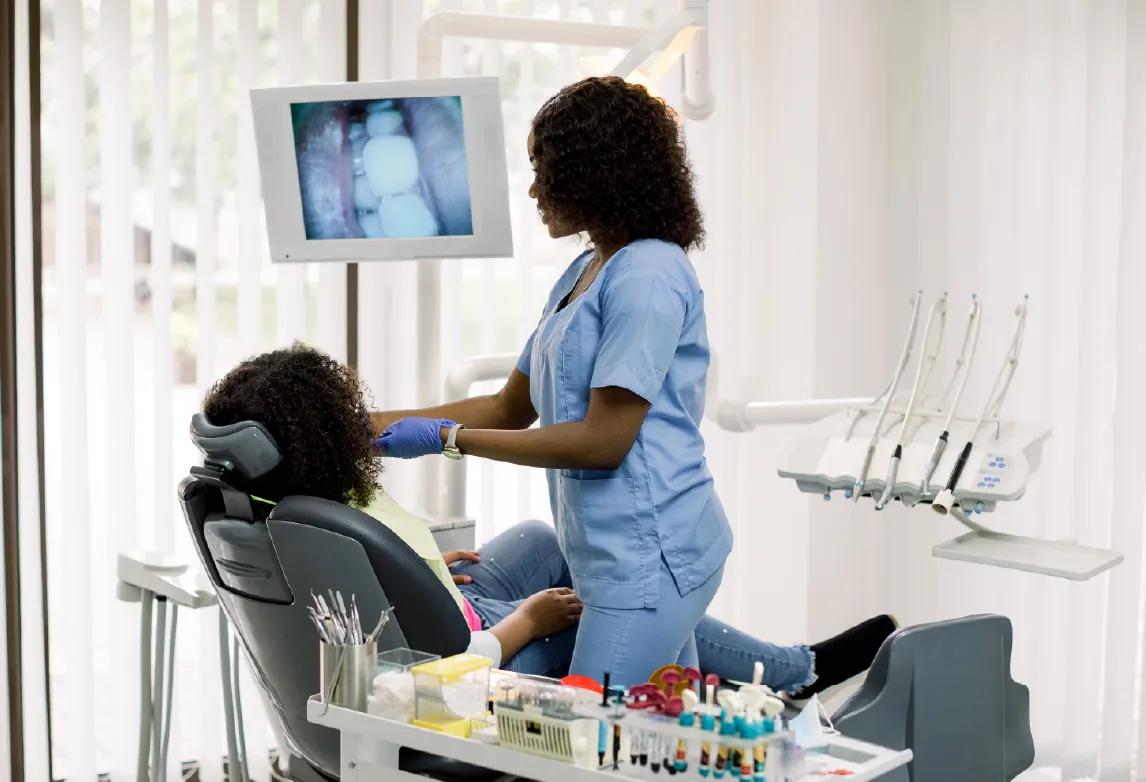
During the workday, dental assistants generally wear scrubs or other types of protective clothing. They also wear safety items like gloves, surgical masks, and safety glasses to protect themselves and patients during dental procedures.
What are other names for dental assistants?
Dental assistants can have varying titles. This is helpful to know when doing a job search for this type of role, as well as potentially giving you an idea of specialty areas you may wish to pursue as a dental assistant.
Some of the titles you may see include:
- Certified Dental Assistant (CDA)
- Registered Dental Assistant (RDA)
- Certified Registered Dental Assistant
- Expanded Function Dental Assistant
- Expanded Duty Dental Assistant (EDDA)
- Surgical Dental Assistant or Oral Surgery Assistant
How much does a dental assistant make?
A dental assistant’s pay can vary based on a variety of factors, including geographic location, level of education and experience, relevant certifications, and more.
To learn more about how much a dental assistant makes in your area, look at local job posts to see what they pay. You might also research wage information online, such as by looking at supplied by the Bureau of Labor Statistics or another source you trust.
What skills do I need to work as a dental assistant?
Aside from having the required technical skills, such as knowing how to sterilize instruments and prepare patients for procedures, it can also be beneficial to have certain soft skills when working as a dental assistant. Soft skills are traits or qualities that can be helpful in the workplace.
Soft skills that are important for dental assistants include:4
- Attention to detail
- Interpersonal skills
- Listening skills
- Being organized
Once you understand what it’s like to be a dental assistant, you’re able to decide if this is the right career path for you. If it is, you’re ready to move on to the next step.
Step #2: Find the Dental Assistant Requirements for Your State
Before becoming a dental assistant, you want to learn the requirements for this role in your state. This tells you what type of education, certification, and licensing you need to pursue an entry-level role as a dental assistant in your area.
What education or training do you need to be a dental assistant?
Some states have specific education requirements, such as graduating from an accredited dental assistant program. These programs generally take roughly one year to complete and include both classroom and lab work.4
Other states have no formal education requirements and enable you to learn through on-the-job training. In these states, although completing a dental assistant program and passing a certification exam aren’t required, doing one or both could help you stand out from other job applicants in this field.
Do dental assistants need to be certified?
Depending on the state, you may also be required to pass an exam. These exams test your competency in key areas involved in dental assisting.
For example, the administered by the American Medical Technologists (AMT) assesses your knowledge in office assisting skills, dental sciences, clinical procedures, and dental imaging.5
Do you need a license to be a dental assistant?
This can vary from one state to the next, but you generally don’t need a license to pursue an entry-level dental assistant role.4 That said, your state may require a dental assistant license for you to work with X-rays, infection control, and certain specialties.
States that allow dental assistants to perform expanded functions — such as coronal polishing, fabricating temporary restorations, and creating impressions — may also require licensing, registration, or certification to work in this role. This is known as an expanded functions dental assistant or a dental assistant with expanded functions.
Learn more: Expanded Functions Dental Assistant Job Duties
How do I know whether I need a dental assistant education, license, or certification to work in my state?
The American Dental Association provides a , including links to their websites, phone numbers, and emails. Contact the board in your state to learn its requirements.
Step #3: Select and Enroll in a Dental Assistant Program
You’re now clear about what this role entails and have learned the requirements in your state. The next step to becoming a dental assistant is to find a program that can teach you the knowledge and skills needed to perform your job functions.
While you may be able to learn on the job in your state, completing a dental assistant program can give you the confidence and skills needed from day one. It can also help you stand out as a job competitor.
What do you learn in dental assistant courses?
Dental assistant training can teach you how to perform both the administrative and dental assisting parts of the position. This type of program can include a combination of classroom learning, laboratory work, and supervised hands-on practice.
Dental assistant courses cover important topics like the gums, teeth, jaw, and other areas inside the mouth. You also learn about dental instruments used during various procedures that dentists perform.
Dental assistant programs that include expanded functions also teach you about more advanced procedures, such as sealant placement, coronal polishing, and how to fabricate and remove temporary crowns.
How much do dental assistant schools cost?
The cost of a dental assistant education varies based on the type of program you enroll in. There can be different costs for certificate programs than associate degree programs, for instance. Some dental assistant programs might also charge additional fees for things like registration, labs, class supplies, and exams.
If the cost is a concern, reach out to the student services department of your dental assistant school to ask about financial aid. Federal financial aid may help cover the costs of your program, class materials, and other related expenses, depending on your eligibility.
What to look for in a dental assistant training program
When researching dental assistant programs, you want to find the right program for you. Here are a few questions to ask yourself to help decide whether a particular program will meet your unique needs:
- Will the dental assistant courses work with your schedule?
- Does the program prepare you for the certification exam needed in your state?
- Do you get personalized attention?
- Does the program teach you the necessary skills to begin work as a dental assistant after graduating?
- Is there help with resume writing and job interview preparation in the program?
- Does the program offer assistance with your job search?
- Is there financial aid available for those who qualify?
- Does the program offer opportunities for hands-on learning experience?
After you find the program for you, enroll and get started on your coursework. This will help prepare you for the next step to become a dental assistant: real-world training.
Step #4: Get Hands-On Experience With Real Patients
During your dental assistant training, you may have the opportunity to gain real-world experience. This could be in the form of an externship, or it could be rolled into the curriculum of the program.
The opportunity to work in a functioning dental office can help you put your education into practice and prepare you for the workforce. It can also make you feel more confident when performing the required duties. Plus, potential employers may look for dental assistants who have some experience with patients in an office setting.
Step #5: Earn Your Dental Assistant Certification
Maybe you’re in a state that requires certification to work as a dental assistant, or a potential employer requires or prefers this credential. Even if it’s not a requirement, taking the step to earn your certification can help you stand out from job candidates who lack this designation.
American Medical Technologists (AMT) offers Registered Dental Assistant (RDA) certification. To apply for this exam, you must meet one of the following qualifications:6
- Graduated from or scheduled to graduate from an accredited dental assistant program
- Completed a military dental assistant program and have one year of experience
- Been employed as a dental assistant for at least three years (5,250 hours)
The AMT’s consists of 210 questions, and you must achieve a score of 70 or higher to pass.7 It tests your knowledge of office procedures, patient management, dental anatomy and terminology, infection control, instruments, chairside procedures, radiograph processing, and more.5
Choosing a dental assistant program that includes certification prep can help you get ready to sit for the RDA exam.
Step #6: Prepare Your Dental Assistant Resume and Begin Your Job Search
Once you’re trained and certified, it’s time to start the job hunt. This begins with writing a compelling resume.
When you create your dental assistant resume, include some of the same language as the job listing. Employers can use an applicant tracking system (ATS), which is software that helps identify qualified applicants. This software works, in part, by looking for keywords in candidates’ resumes, and these keywords can come from the job post.8
If you’re new to the field, build your resume around your education and training. Include the skills you learned in your coursework and any externships you participated in. Also include any relevant certifications.
Your school may be able to help you prepare your resume so it’s optimized to highlight your skills. Some schools even offer assistance with your job search.
Step #7: Interview for a Dental Assistant Job
When you find a potential employer and apply for a position, your last step before getting hired is the interview. Preparing for this interview in advance can be the difference between walking in (or appearing virtually) with confidence in your abilities and feeling overwhelmed.
Think about the questions you may be asked and how you will answer them. Also, plan what you’ll wear to the job interview, trying it on to make sure it portrays the message you’d like.
After the interview is over, send a thank-you note or email. Thank them for taking the time to meet with you and gently reinforce why you’d be a good fit by referencing something from the interview.
Step #8: Get Hired and Begin Your Career as a Dental Assistant
After training, certification, and nailing your interview, all that’s left is getting an official job offer. Then you’re ready to begin your career as a dental assistant.
Even if you’re not hired, remain respectful and thank the interviewer for considering you. Future opportunities might arise, so end on a positive note. You could also ask the interviewer if there is anything you need to improve upon in the future.
Ready to Start Your Journey to Becoming a Dental Assistant?
This is the journey to becoming a dental assistant in eight steps. If you’re ready to start your journey, Ultimate Medical Academy (UMA) offers a Dental Assistant With Expanded Functions Diploma program that can be completed in 12 months or more9 and includes a 240-hour externship. It also prepares you to sit for the RDA exam should you decide to pursue certification.10
UMA offers a variety of student services, helping you navigate admissions and financial aid, as well as assisting you with your coursework and even your job search. Our goal is to support our learners throughout their healthcare education journey, which means that we are here for you well beyond graduation.
Reach out and let us know how we can help you, or to ask us any questions you may have.
Where national data regarding earnings or employability within a particular field are cited, individual readers should take note that national averages may not accurately reflect the earnings of workers in their particular part of the country, and may include earners at all stages of their career, not just entry-level wages for recent graduates.
1 Bureau of Labor Statistics. Occupational Outlook Handbook. Dental Assistants. Job Outlook.
2 Bureau of Labor Statistics. Occupational Outlook Handbook. Dental Assistants. What Dental Assistants Do.
3 Bureau of Labor Statistics. Occupational Outlook Handbook. Dental Assistants. Work Environment.
4 Bureau of Labor Statistics. Occupational Outlook Handbook. Dental Assistants. How to Become a Dental Assistant.
5 AMT. Registered Dental Assistant (RDA) Certification Competencies and Examination Specifications.
6 AMT. Dental Assistant (RDA).
7 AMT. AMT Candidate Handbook.
8 Indeed for Employers. Applicant Tracking Systems: Key Features and When You Need Them.
9 Completion times vary according to the individual student.
10 Learners must meet eligibility criteria to sit for applicable certification exams.
Frequently Asked Questions About Becoming a Dental Assistant
What do you need to be a dental assistant?
How long does it take to become a dental assistant?
How to become a registered dental assistant (RDA)?
Do you need a degree to be a dental assistant?
Can you get a dental assistant 2-year degree online?
Request Information
Talk with us. Start your journey.
Complete this form and we'll call you to explore options at UMA and answer your questions. We'll also email you info on how to get started. We're with you at every step!
Request Information
Talk with us. Start your journey.
Complete this form and we'll call you to explore options at UMA and answer your questions. We'll also email you info on how to get started. We're with you at every step!
About the Author
 Christina DeBusk
Christina DeBusk is a freelance writer who has been providing health and wellness content to healthcare organizations such as the American Chiropractic Association and International Sports Sciences Association (ISSA) since 2011. She obtained her Bachelor of Science in Sociology from Central Michigan University, minoring in psychology. She has also earned several ISSA certifications, including Certified Personal Trainer and Certified Nutrition Specialist, achieving the status of Elite Trainer.
Related Content